 DEX screener
DEX screener token research through charts and pair data
DEX screener brings decentralized exchange charts, trading activity and liquidity data together for researching token pairs. A pair identifies the assets traded against each other in a particular pool. Reading that pool's identity alongside its figures helps distinguish an interesting chart from a market suitable for further research.
Key takeaway: A token chart describes trading in a particular pool, while available liquidity and trade size affect how closely a proposed swap can follow that price.
Pair identity and the market behind the chart
A pair's network, token addresses and pool address determine which market its figures describe. The base token is the asset whose price the pair expresses; the quote token provides the trading counterpart. Pair records distinguish these assets and identify the exchange associated with the pool.
Names and symbols help with discovery, but different tokens can share them. An address match on the intended network provides a more precise identification. A token address identifies the asset, while a pair address identifies a particular trading pool. Confusing those addresses can lead to comparing unrelated records.
Even the intended token can trade in several pools. Their counterpart assets, available liquidity and trading histories can differ. Those differences explain why selecting a search result deserves attention before interpreting its chart.
Liquidity and the depth available to a swap
Liquidity describes assets available in a pool, while price impact describes the price movement caused by a trade. The relationship matters because a displayed market price does not establish the average price available for an entire order.
Trade size relative to pool depth
A larger trade relative to available liquidity generally causes greater price impact in an automated market maker. A smaller trade in the same conditions generally causes less. Consequently, the same chart can accompany very different execution outcomes for different order sizes. Comparing liquidity without considering the proposed amount leaves out an essential input.
Liquidity within active price ranges
In pools that use concentrated liquidity, providers allocate assets to selected price ranges. Liquidity outside the current range does not provide active depth at that price. A pool's total value therefore cannot fully describe how much trading it can absorb nearby. The applicable pool design and distribution of liquidity both matter when evaluating a quote.
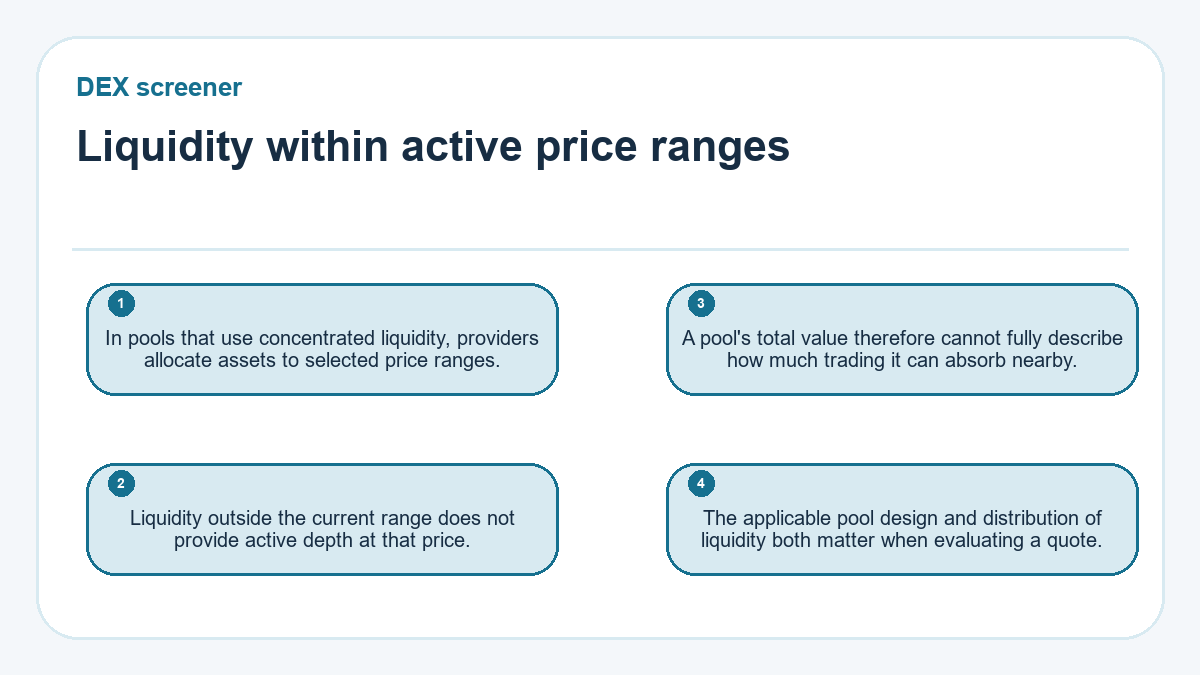
Chart changes across time intervals
A candlestick chart groups price observations into the selected interval. Each candle records an opening price, a high, a low and a closing price. Longer intervals combine more activity, which changes the visual detail without changing the underlying trades.
Short intervals expose brief movements that longer candles compress. A long wick shows that the recorded price reached beyond the candle's opening and closing levels. It does not reveal how much liquidity was available throughout that movement. A dramatic shape can therefore warrant closer examination without establishing that a large order could have traded at its extreme.
The candle currently forming can still change.
Keep the price denomination consistent when comparing charts. A token's value against its trading counterpart and its value expressed in dollars answer different questions. Neither view predicts the next trade, and switching intervals cannot supply trading history that the selected pool does not have.
Volume and transaction counts over matching periods
Volume measures traded value over a period, while transaction counts describe how many recorded trades occurred. These figures answer different questions about activity. A comparison becomes misleading when its volume window differs from its transaction window.
Buy and sell counts also need their own interpretation. More buys than sells does not establish that buying volume was greater: transactions can have different sizes. Likewise, repeated activity does not establish a matching number of independent people. Pair data provides transaction and volume fields separately, so combining them requires attention to their periods and units.
Liquidity is a pool condition at a particular point, whereas volume accumulates across an interval. Strong past turnover does not reserve liquidity for a future order.
Supply assumptions behind FDV and market capitalization
Fully diluted valuation, or FDV, combines the displayed token price with a supply figure. DEX screener calculates FDV as total supply minus burned supply, multiplied by price. Market capitalization may instead use reported circulating supply when that information is available for tokens with supply outside circulation.
Equal FDV and market capitalization figures do not independently prove that every token is circulating. Their interpretation depends on the supply information used. A missing figure also gives no basis for treating the valuation as zero.
Neither valuation measures cash deposited by buyers or funds available for withdrawals. Multiplying a marginal price by supply produces a valuation, not an executable sale quote for that supply. This distinction becomes especially relevant when a high valuation accompanies limited pool liquidity.
Discovery filters and the influences on trending
Discovery views select candidates for research using different criteria, so their ordering needs context. New Pairs emphasizes recently created pools, while Gainers & Losers emphasizes price movement. Filters narrow the displayed selection.
Activity and attention in rankings
The Trending Score considers market activity alongside engagement and other signals. Its inputs include volume, liquidity, transactions, holders and visits to a token's page. Because several influences contribute, a position in the trending list cannot be read as a simple ranking by trading volume. The complete weighting is not public.
Paid visibility through Boosts
Boosts temporarily increase a token's Trending Score through a multiplier. They influence visibility without replacing the other ranking inputs, and purchasing them does not guarantee a particular position. A Boost indicator therefore supplies context about promotion; it does not establish a token's economic value or the quality of an execution quote.
Filtering and sorting organize a research queue. A strict selection can hide relevant pools, while a broad selection leaves more unrelated results to examine.
Does appearing on DEX screener mean a token passed a security review?
Appearing in the screener does not establish that a token passed a security review. Listing is automatic when a token has a liquidity pool and at least one transaction within tracked coverage. Market data comes from automated processing of blockchain activity.
A trading record establishes that activity occurred under particular conditions. It does not prove that every wallet can sell, that contract permissions cannot change or that liquidity will remain available. Those questions concern token behavior and pool control, which a rising chart alone cannot answer.
Where a security indicator appears, interpret the specific property that it reports. A check addressing one contract property cannot establish every other property. Descriptions, logos and social links likewise identify a presentation, rather than proving control of the associated token.
Watchlists and alerts for continued research
Watchlists, alerts and Multicharts support returning to selected markets without rebuilding a search each time. Check which pool a saved chart tracks before comparing its figures with another pool's.
Monitoring also needs a consistent basis. Comparing a later value with an earlier one makes sense only when the asset, pool and measurement agree. An alert draws attention to a condition; it does not reserve the market state that triggered it. This makes monitoring useful for deciding when to inspect a market again, rather than treating a notification as an execution instruction.
A decision checklist for an uncertain search result
A mismatched search result should be resolved before its figures influence a token decision. Suppose a symbol search returns a promising chart, but the displayed token address differs from the intended address. The chart's performance cannot resolve that identity mismatch.
- If the token address differs, repeat the search using the intended address rather than the symbol.
- If the network differs, restrict the comparison to the intended network before comparing figures.
- If several pools match, distinguish their pair addresses and counterpart assets.
- If a required liquidity or valuation field is absent, leave that comparison unresolved.
- If the identity matches, evaluate the selected pool's available figures on a consistent time basis.
After searching again, confirm that the result displays the intended token on the intended network and identifies the pool being examined. Address matching is the durable requirement; prices and available liquidity are changing conditions. If the intended identity remains uncertain, stop at the search result rather than substituting another token with a similar name.
The boundary between research and a swap quote
A swap quote evaluates a proposed exchange of assets under the conditions available when the quote is produced.
The proposed amount, trading route and pool liquidity affect the expected output. Fees also belong to the execution calculation. A chart's last recorded price cannot incorporate every consequence of a new order, particularly when that order moves through meaningful portions of the available liquidity.
Price movement before execution can change the outcome further. Slippage tolerance limits the deterioration that an execution request permits under its applicable rules. Increasing that tolerance does not add liquidity or repair an incorrect token selection; it changes the acceptable execution boundary.
The next decision is whether the identified market warrants a quote for the intended amount. When identity or essential market data remains unresolved, further research is the appropriate stopping point before authorizing a transaction.
DEX screener questions, answered
Can I browse token charts without connecting a wallet?
Public market browsing does not require a wallet connection. Search and market discovery are available through the public interface. Reading a chart is separate from authorizing a blockchain transaction, so a request to approve spending should be assessed as a separate action with its own token, amount and permissions.
Which mobile operating systems have an app?
DEX screener has apps for iOS and Android. App availability does not establish that every browser feature works identically on mobile. In particular, the documented Boost purchase flow uses a web browser rather than the mobile app.
How can software retrieve pair data?
Software can retrieve pair data through the public API. It supports pair searches and lookups using chain and token or pair identifiers. Endpoint limits apply, and some response fields can be absent or null. An integration should preserve the distinction between unavailable information and a measured zero instead of silently replacing one with the other.
Is there a native DEX screener token?
DEX screener states that it does not have a token. A token or presale using its name therefore does not establish a relationship with the service. Branding can be copied, and appearing in search results does not authenticate an issuer. Treat the claimed connection as a separate identity question from whether the token has trading activity.
What does a pool's creation time reveal about the token?
A pool's creation time identifies the age of that pool, not necessarily the age of the token. A token can have more than one trading pool, so a recently created pair does not establish a recent token launch. Keep pool history separate from token issuance history when interpreting a newly appearing market.
Are token descriptions taken directly from blockchain transactions?
Token descriptions and social information can come from external token lists or Enhanced Token Info. These details have a different origin from indexed trading activity. A complete profile therefore does not show that every descriptive claim was established by a blockchain transaction, and missing profile information does not by itself establish that the pool has no trades.
When can a new token become eligible for automatic listing?
A token becomes eligible under the documented listing conditions after it has a liquidity pool and at least one transaction within tracked coverage. Creating a token alone does not meet those conditions. The listing rule is not a fixed processing deadline, so it should not be interpreted as a promise that every new pool appears after an identical delay.
updated